When Was My Glock Made - A very common question for new Glock buyers is "Is my Glock a general?" Prior to the release of the fourth generation, Glock was not officially recognized by the unique model number, contributing to the idea that "a Glock is a Glock is a Glock: they are all the same." But early collectors noticed the differences and informally decided on three main iterations, or "generations," to sort by. The nomenclature became so common that Glock followed suit with the release of the Gen 4 in 2008, and its promotional literature now highlights the previous Gens in some places.
The images below will help you clearly identify which generation your Glock is a part of, but be aware that there is a lot of overlap as the models gradually carry over. Also, 3rd gen guns are still in production due to California gun restrictions, so you could have a 5th gen gun that is actually older than your 3rd gen. Photo notes identify key features that are consistent between generations, but minor changes to markings and internals can be found at different intervals (and sometimes back and forth) within the same generation. Thus, the hard break between generations designates only significant frame modifications, many parts are interchangeable in two or more, but some changes last only a short time in one generation.
When Was My Glock Made

The first generation was one of constant change. The initial design, while reliable, was still under development. A consistent feature is the grip texture that wraps around the entire grip (no front or back strap check). It has a smoother feel than later generations and is considered by collectors to have a "pebble texture". Early guns had a thin stainless steel barrel with a Parkerized finish introduced early (no later than the AD prefix) and the barrel wall thickness was not increased until later than the AN prefix. There are also several variations on magazines, cases and small internal parts. All guns will have Austrian proof marks, but will not have consistent placement or numbering of the marks. Very old (pre-US) guns and frames designated for the European market do not have serial number plates. Most early guns were also mounted on targets known as "weekend sights" due to their fragility. The standard (fixed) sights are also period correct, although the target version will come at a premium. All frames had a half-moon relief below the front strap.
Shooting Review: The Glock 19 Gen 5
2nd Gen is what many novice collectors or even uninformed dealers will refer to as "Gen 1". The confusion stems from two factors: 1. Early generations are very rare and many casual observers have not seen them before. 2. Many models were introduced in the 2nd Gen line and some consider them to be "1st Gen" because this is the first issue of that particular model. To make things clear, if you have a model 20 or older, you have a Gen 2 Glock even though it is the first version of that gun ever made. The obvious difference between the 1 and 2 for the 17-19 models is that frames have been added to the front and rear straps, as well as a change in the texture of the side panels (deeper than the 1st generation). Generation 2 also saw the introduction of 5 additional calibers and all non-.380/9mm barrels were fitted with a second locking pin to prevent the frame from cracking due to heavy recoil. It is important to note that the number of pins does not designate the generation, as many believe. Production ben 1 through Gen 3 in 9mm frames will only have two pins while the other calibers will have 3 pins. All full-size frames carry magnetic well relief under the front strap.
By the late 1990s, Glock had become a dominant force in the American gun market, and other manufacturers scrambled to copy the design. This led to some pressure to "innovate" Glock's design to try to stay ahead of the pack. The third generation changes began in 1995 with the release of subcompact models. Reverse rotation. This started a 3 year transition period until full changes came to all models in 98. Some larger frame transition models are quite rare (especially in ported variants) - see https:///transitional/ for more information A 3rd generation front strap will have finger slots, thumb rest notches at the top of the grip, and an accessory rail molded into the dust cover. As mentioned above, for 9mm calibers only, you still get the 2-pin design during the initial 3rd gen run. In the early 2000s, the frames were simplified to all 3 pins.
By the time the 4th generation arrived, Glock had become ubiquitous for “pistols,” but was again facing challengers with more innovative designs. One fad that attracted consumers was interchangeable backstraps to better fit grips of different hand sizes. Glock first experimented with narrow grips on the Gen 3 SF model (they were only available in .45 and 10mm calibers). The modular rear strap system brings SF proportions to all frames with two sizing options and even a beavertail adapter. The internals were redesigned from the ground up and actually built with the .40S&W and then 9mm recoil profile in mind (whereas Gen 1-3 were designed the other way around). This should prove to make the .40 models more durable while continuing the legendary reliability of the 9. The grip texture has been changed to a more aggressive pattern on the side panels; again, the so-called "RTF2" texture was briefly tested on third-generation state-of-the-art weapons. RTF2s are technically Gen 3, possibly Gen 3.5 and were only produced between 2009 and 2011 (excluding period special editions) - see image at bottom of this page.
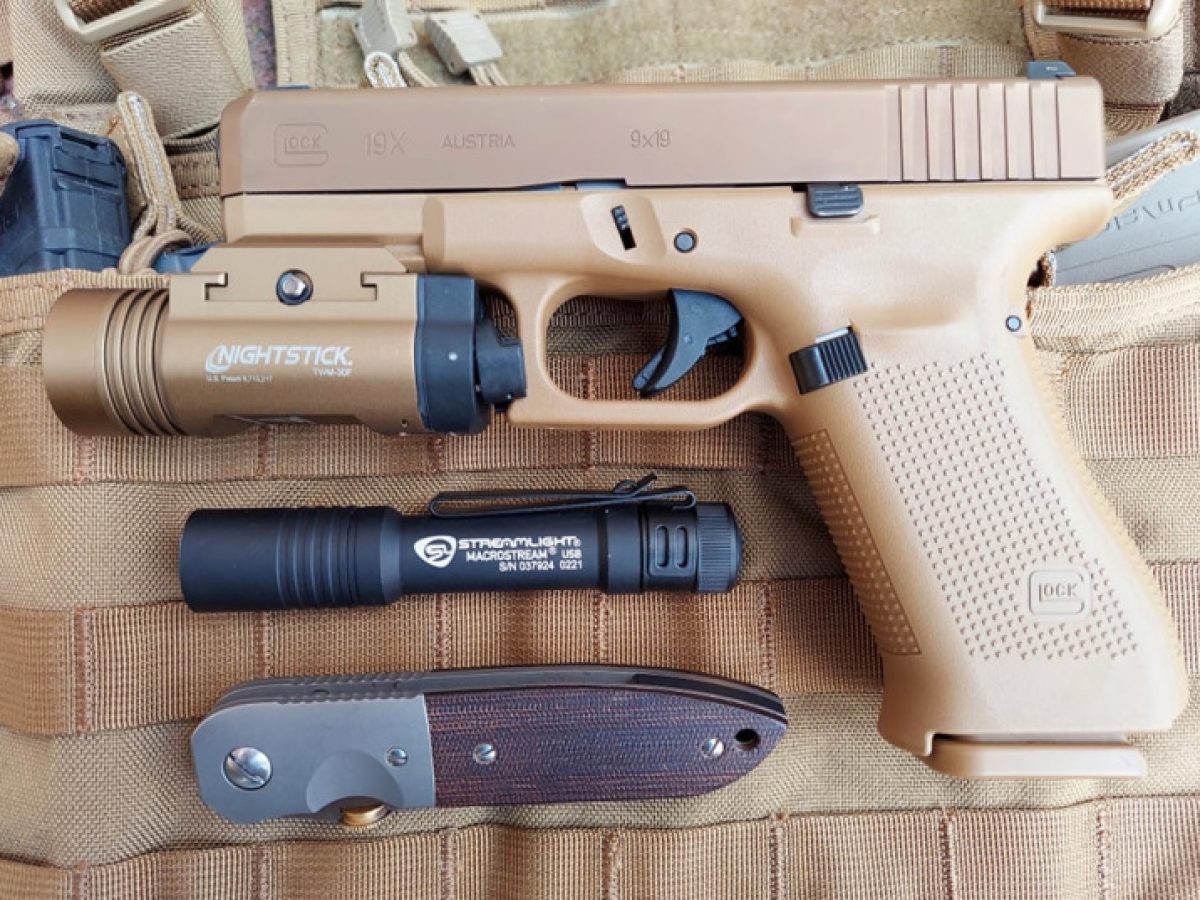
The first Gen 5 models actually preceded the release of the new subcompact models 42 and 43. These models began as basic redesigns with all new internal components to accommodate the smaller dimensions, and the FBI played a role in implementing these changes with its request for that the M model progressed to larger guns. The 19X, 42, 43, 43X, 44, 45, and 48 do not technically carry a Gen 5 designation on the slide, but are nonetheless more in line with the other Gen 5 guns. The 17 and 19 were officially released as Gen 5 in 2017 and were followed by other offers in 9mm and .40 S&W, but so far no offers have been made in .357 Sig, 10mm or .45 ACP. Major notable changes include the "shooter" barrel, all-dark controls, flared magwell, and removal of the front strap finger slots.
Best 9mm Glocks [ultimate Models Guide]
(At least) two other designs can be found that actually transcend generational differences or are different enough to be difficult to identify from the above discourse: 1. Third Gen RTF2 and 2. FBI M Series.
RTF2 is short for "Rough Texture Frame, Second Edition". The first version was made only as a prototype and was never released although at least one is on display at the Cody Firearms Museum. The designers landed on the second version and new molds were made to incorporate this grip texture into a standard 3rd generation design. All internal parts are the same so the only difference will be the grip texture. As you can see in the blown up photo, the entire grip is covered in little pyramids, and let me tell you, they are sharp. This gun will stick to your hand very well, even when it's wet. From 2009 to 2011 Glock marketed these primarily to the police, but the design is a clear step between the third and fourth generation guns. The pyramid concept was carried forward but with larger pyramids because the RTF2s were prone to wear through clothing. See https:///rtf2g/ for more images.
Finally, we must also talk about the FBI's M-series pistols. The 17M and 19M actually preceded and presumably inspired the Gen 5 guns. They were built to specifications requested by the FBI as a new departmental service weapon and incorporated some new ideas as well as some design changes from the Mini 42/43 models. These were the first Glocks to feature ambidextrous controls and rifle modifications designed to improve accuracy. While on the outside, the M gun will look and feel almost exactly like a Gen 5, the main differences are internal so most collectors will consider them part of the Gen 5 family. But for the right person, adding an "M" to the brand of the model will make a big difference in your price choice
When was coffee made, how to find out when my glock was made, when was football made, when was my lufkin rule made, when was my car made vin, when was samsung made, when was my rolex made, when was mcdonalds made, when was hennessy made, when was ninjago made, when was tv made, when was computers made

0 Comments